The Death of the Middle Seat: How the Premium Pivot Is Rewriting Airline Economics

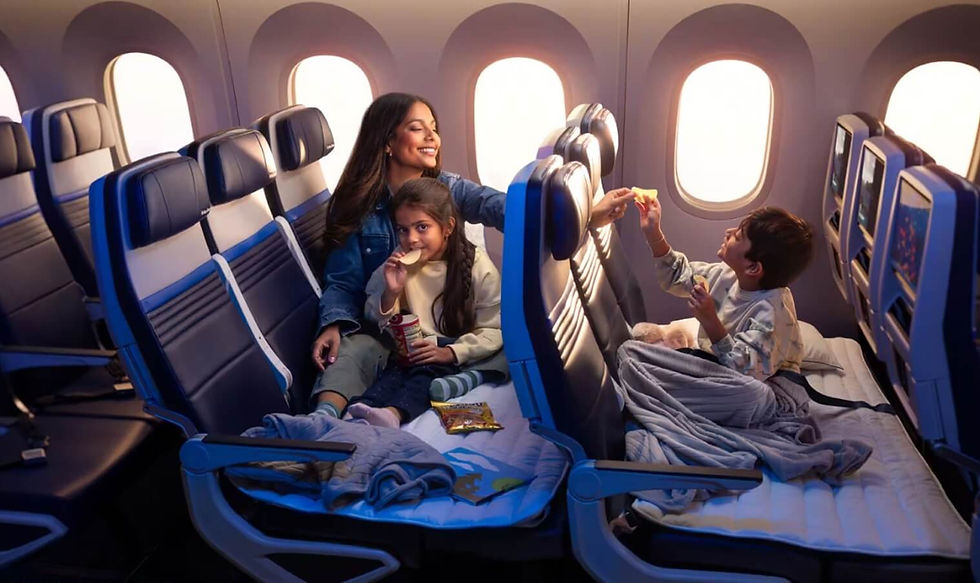
Photo: United Airlines
In the fourth quarter of 2025, something happened at Delta Air Lines that had never happened in the company's nearly 100-year history. For the first time ever, the airline made more money from the front of the plane than from the back. As reported in Delta's fourth-quarter 2025 earnings results, premium cabin revenue reached $5.70 billion, edging past main cabin's $5.62 billion—premium up 9% year over year, economy down 7%.
It wasn't a fluke. A company that built its name moving the masses had quietly become a business that, for one quarter, made its money from the few who pay more. (For the full year, main cabin revenue still edged ahead—but the gap has narrowed to the point that a full-year crossover is widely expected.) Most travelers didn't notice. But for anyone who works in or around aviation, this milestone signals one of the most significant structural shifts in the industry in decades—and it runs far deeper than seat maps.
This Isn't a Delta Quirk—It's the Entire Industry
Across the major U.S. network airlines, the same pivot is underway, and management teams are saying so openly. As reported from Delta's Q4 2025 earnings call, CEO Ed Bastian told reporters that "virtually all" of the airline's seat growth in 2026 will come in premium cabins, anchoring a projected double-digit jump in full-year profit.
United has moved the same direction. In March 2026 the carrier unveiled new cabin designs—including on some of its smallest aircraft—that add premium seating while cutting standard coach, a strategy one report summed up as "fewer but better seats." United's own executives have been explicit about why. Speaking to reporters, Chief Commercial Officer Andrew Nocella said that while the main cabin was improving, "premium did lead the way yet again in the quarter, and continues to do so." The hardware backs the rhetoric: United's new-generation Boeing 787-9, as reported ahead of the aircraft's 2026 introduction, is configured with roughly 64 business-class and 35 premium-economy seats against just 123 in economy—down from around 188 economy seats on earlier versions, dedicating nearly half the cabin to higher-paying passengers.
American has said the same. As stated in American Airlines' first-quarter 2026 financial results, its lie-flat and Premium Economy seats grew more than twice as fast as Main Cabin seats in the quarter, and the company now lists driving premium revenue and leading in loyalty among its four core commercial priorities. As outlined in American's accompanying Q1 2026 earnings materials, the airline expects to grow its lie-flat seating by roughly 50% by the end of the decade, concentrated on long-haul international aircraft.
Three different airlines, three different fleets, one identical direction of travel. That convergence is worth pausing on—because the obvious objection is that it might mean nothing at all.
Is This Just the Cycle? The Case Against—and Why It Fails
A fair skeptic would say: we have seen premium demand surge before, and it has always cooled. The years since the pandemic produced an unusual concentration of affluent travelers chasing experiences, flush with savings and freed from the office. On this reading, the premium boom is simply the top of a demand cycle—revenge travel in a nicer seat—and when the economy turns and corporate budgets tighten, the front of the plane will empty out and airlines will quietly rediscover the virtues of high-density economy. Convergence among carriers, in that view, isn't insight; it's herd behavior, every airline chasing the same temporarily fat margin at the same time.
It's a reasonable argument. It's also, we think, wrong—and the reason is in what the airlines are actually doing, not just what they're earning. Demand cycles are met with pricing and capacity tweaks: you raise fares, shuffle aircraft, adjust schedules. What's happening now is different in kind. Carriers are physically ripping out and reconfiguring cabins, committing multi-year retrofit programs and ordering aircraft built around larger premium sections. You do not tear apart a widebody fleet to capture a demand spike you expect to fade. Capital expenditure of that scale and irreversibility is a statement of belief about the next decade, not the next two quarters. The convergence matters precisely because it shows up in steel and seat tracks, not just in a single quarter's revenue line.
Why Premium Wins: It's Not Just Nicer, It's Better Business
The pivot isn't driven by a sudden fondness for champagne and lie-flat seats. It's cold math, and it works in three ways.
First, it's the most profitable use of space. A cabin is fixed real estate; the only question is how to monetize each square foot. A premium seat takes up more room than a coach seat, but it earns disproportionately more—and on the routes where demand supports it, that trade is overwhelmingly favorable. It is no accident that the airlines reconfiguring their widebodies are doing so to add premium seats, not remove them.
Second, premium demand is more resilient. Economy demand wobbles with consumer confidence; leisure travelers trade down or stay home. Corporate and affluent travelers are far less price-sensitive, so premium revenue tends to hold up precisely when the broader economy gets shaky. In an era of uneven sentiment and volatile fuel costs, a revenue stream that doesn't crater in a downturn is worth a great deal.
Third, there's the corporate tailwind. Business travelers buy higher-yield tickets and fill premium cabins, supporting not just margins but network stability. Despite years of predictions that video calls would kill business travel, demand for face-to-face interaction has proven durable—and its steady return is one of the most valuable trends of the decade for network carriers.
The Flip Side: The Middle Is Getting Squeezed
Every strategic shift creates winners and losers. As premium cabins expand, standard economy seats contract—especially on busy, premium-dense routes where airlines can extract more value per square foot. Fewer coach seats on high-demand routes generally means higher economy fares. The pattern is already visible in the carriers' own numbers: premium revenue climbing while main cabin softens, a divergence the airlines themselves describe as widening segmentation between cabins.
The product is bifurcating. Airlines are building richer experiences for travelers who can pay, while standard economy becomes more commoditized, more crowded, and often more expensive. The comfortable middle—a decent seat at a reasonable price—is becoming harder to find.
Who Can't Follow: The Structural Trap
Here's what makes the premium pivot so dangerous for some carriers: not everyone can follow, even if they want to. Moving upmarket requires the right aircraft, the right brand, and the right network—and a whole class of airlines is missing at least one of the three. But the trap isn't identical everywhere; it takes two distinct forms.
The short-haul, single-type model: locked out at the gate. Europe's ultra-low-cost giants—Ryanair and easyJet—are built on a single narrowbody family flying short intra-European hops. They aren't losing a premium revenue comparison on those routes, because on a 90-minute hop nobody offers lie-flat; there's no premium money on the table to lose. Their constraint is more fundamental: with no widebodies and no long-haul network, they are structurally shut out of the premium game entirely. The pivot is happening at the front of long-haul cabins, and these carriers don't have a long-haul cabin to reconfigure. They aren't being out-competed for premium revenue—they were never in the room.
The transcon narrowbody model: out-competed on the same routes. The sharper trap belongs to single-type operators that do fly premium-dense routes—above all the U.S. transcontinental market, where narrowbody carriers compete directly against rivals running true lie-flat business class on routes like New York–Los Angeles and New York–San Francisco. Here the revenue penalty bites in full. An extra-legroom row generates only modest incremental revenue per passenger, while a competitor's lie-flat suite on the very same route can earn many times more per premium seat. Scale that gap across hundreds of aircraft and thousands of daily flights, and a single-type fleet that was once the source of a cost advantage becomes the source of a revenue ceiling. These carriers are in the room—and being out-earned seat for seat.
Two different mechanisms, one shared lesson: in a market reorganizing around premium value, an airline's aircraft, brand, and network either give it permission to follow the money—or they don't. A homogeneous fleet was the great cost-advantage of the last two decades. It is becoming the great constraint of the next one.
The Strategic Read: Pick a Lane
If the realignment is real, the implication for any individual carrier is uncomfortable but clarifying: you have to choose. The winners in this shift are choosing a customer and building everything—cabins, lounges, loyalty, network, retrofits—around that choice. The danger isn't picking the premium lane or the value lane; it's pretending you don't have to pick at all, and ending up with a product that's too expensive to win on price and too undifferentiated to win on experience.
There's genuine risk on the premium side too, and it's worth naming honestly. Over-index on the front cabin and a carrier is exposed if affluent demand ever softens, having ceded the volume market to whoever stayed to serve it. Premium is not a guaranteed bet—it's a chosen one. But the carriers making that choice deliberately are in a far stronger position than those drifting into the middle by default. Every airline now faces the same two-part question: who is your customer, and does your fleet actually allow you to serve them?
Why This Matters Beyond the Airlines Themselves
This realignment doesn't stop at the airlines. It resets the priorities of everyone who sells into them. An airline's capital budget is a map of its strategy, and that map is being redrawn toward the front of the cabin—toward seat manufacturers, interior retrofitters, lounge and catering partners, premium loyalty platforms, and the data tools that identify and retain high-value flyers. The budgets attached to high-density, lowest-cost operations are not growing at the same rate; in some cases they are shrinking.
For any company that builds for or sells to airlines, that creates a sorting question with real consequences. A product pitched at maximizing economy throughput is competing for a slice of spend that is no longer the priority. A product that helps an airline win, serve, and keep premium customers is aimed at the budget that is actively expanding. The strategic question airlines face has a precise mirror image for their suppliers: is what you sell aligned with where airline value is moving, or with where it's receding?
The Bottom Line
The middle seat isn't disappearing. But the middle strategy is. The airlines pulling ahead have made a clear choice about who they serve and rebuilt their economics around it. The ones at risk are those whose fleets, brands, or models won't let them follow the value—and those who keep hoping they won't have to decide. Delta's quiet milestone wasn't really about one airline crossing one revenue line. It was the clearest signal yet of where commercial aviation is heading. The question for everyone in this industry—airlines and the companies who serve them alike—is whether they've read it correctly.
___________________________________________
Navigating the premium realignment—on either side of it.
The Cileo Group works with airlines making these strategic choices and with the companies that build for, sell to, and partner with airlines. Whether you're positioning your product, your network, or your business for where aviation value is migrating, understanding the shift is the first step to capitalizing on it.
Contact The Cileo Group to discuss what the premium pivot means for your strategy—and how to position for the next decade of airline economics.
___________________________________________
Sources
All financial figures are drawn from the airlines' own publicly reported results. Readers can verify each directly:
Delta Air Lines — December Quarter and Full Year 2025 Financial Results (Jan. 13, 2026). Premium vs. main cabin revenue figures and 2026 premium seat-growth commentary. ir.delta.com — December Quarter and Full Year 2025 Financial Results
American Airlines Group Inc. — First-Quarter 2026 Financial Results (April 23, 2026). Premium and Main Cabin seat-growth figures, four commercial priorities, and lie-flat growth target. American Airlines Newsroom — Q1 2026 results | SEC Form 8-K (Exhibit 99.1)
United Airlines — March 2026 cabin redesign announcement and Boeing 787-9 "Elevated" interior configuration; CCO Andrew Nocella remarks to reporters. New-generation 787-9 seat counts and premium-demand commentary, as reported in contemporaneous coverage of United's announcement and the airline's own materials at united.com. The phrase "fewer but better seats" is a press characterization of United's strategy, not a company statement.
Note on figures: Delta's premium-over-main-cabin crossover reflects fourth-quarter 2025 results; for full-year 2025, main cabin revenue remained marginally higher. American's roughly 50% growth figure refers specifically to lie-flat seating, concentrated on long-haul international aircraft; American's broader premium seating is reported to grow at about twice the rate of main cabin. United's 787-9 seat-count figures reflect reported configurations of the new "Elevated" interior and may vary by specific aircraft tail and route deployment.